


Do Higher-Efficiency Solar Panels Improve Commercial Solar ROI in Australia?
September 29th, 2026
Short answer:
Yes, higher-efficiency solar panels can improve commercial solar ROI in several ways. They deliver more DC capacity from the same roof area, increasing generation potential and, for eligible systems, the upfront STC discount. They can also achieve a target system size with fewer modules, helping reduce mounting equipment and installation labour.
That smaller footprint gives designers more freedom to use the best unshaded roof areas and avoid edges and corners where additional mounting supports or installation restrictions may apply. Together, these advantages can help businesses get more value from their roof space and solar investment.
What does “high efficiency” mean for commercial solar?
Solar panel efficiency is the percentage of sunlight hitting a panel that is converted into electricity. A higher-efficiency panel converts more of that sunlight into power, so two panels with the same dimensions can have different wattage ratings.
For commercial solar, this means higher power density: more watts of installed capacity per square metre of panel area. It allows a business to fit more capacity onto the available roof or reach its target system size using less space.
For example, a 670W module provides around 6.35% more rated DC capacity than a 630W module of the same dimensions. Across a commercial rooftop, that difference adds up making each square metre work harder for the business.
How can higher efficiency improve commercial solar ROI?
Higher efficiency makes better use of the roof space available, with benefits that can extend from lower installation costs and higher eligible STC discounts to greater electricity bill savings over the system’s life.
Higher efficiency makes better use of constrained roof space. The financial benefits can extend from higher installed capacity, higher eligible STC discounts, lower installation costs to greater generation and electricity bill savings over the system’s life.
More capacity from the same roof
Compare a 670W AIKO COMET 3N72 module with a 630W TOPCon module of the same dimensions 2,382mm × 1,134mm.
The AIKO module delivers 40W more rated capacity per panel, adding 6.35% more DC capacity with the same number of panels and roof footprint. For a business with strong daytime electricity demand, that extra capacity can help cover more of its consumption with solar.
| Metric | AIKO COMET 3N72 | Same-size TOPCon | Difference |
|---|---|---|---|
| Module power | 670W | 630W | +40W |
| Physical footprint | Approx. 2,382mm x 1,134mm | Approx. 2,382mm x 1,134mm | Same-size comparison |
| Module efficiency | 24.8% | 23.3% | Higher power density |
| Capacity | 131.32kW DC | 123.48kW DC | +7.84kW / +6.35% |
This is the key distinction for commercial solar buyers: a high-power module does not create extra roof area, but it can extract more DC capacity from the roof space and module count that a project can actually use.
Higher value from commercial solar rebates
Higher-efficiency panels can help reduce the upfront cost of commercial solar by fitting more eligible DC capacity onto the same roof. STC entitlement is based on installed capacity, location and the applicable deeming period, so more capacity can mean a larger upfront discount, even with the same number of panels.
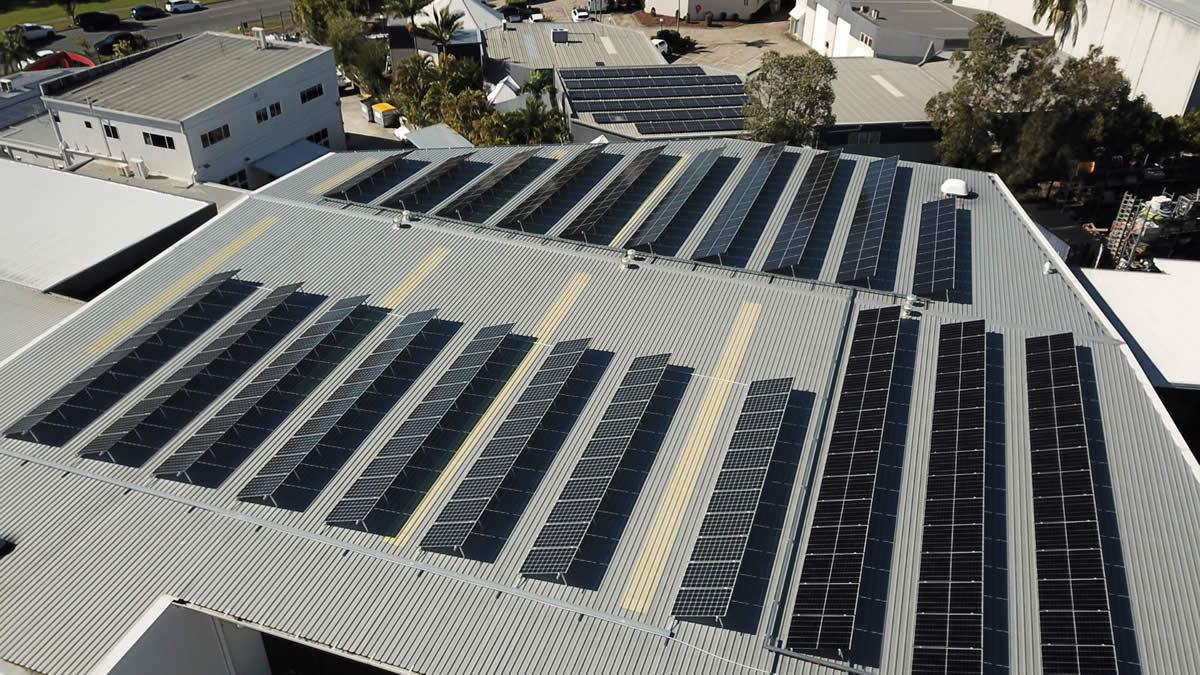
The Australian Government has announced plans to expand the Small-scale Renewable Energy Scheme (SRES) to eligible solar systems up to 1MW, intended to apply from 1 October 2026, subject to final regulations. The government estimates the expansion could lower upfront installation costs for commercial, industrial and agricultural projects by around 20%.
For the same module count, choosing 670W AIKO modules over 630W modules adds 6.35% more DC capacity. Under the proposed arrangements, that extra eligible capacity would translate into approximately 6.35% more STCs, giving businesses a larger discount to help offset their investment. This brings a financial benefit from higher efficiency before the system starts generating electricity.
The examples below show the additional STCs and upfront discount for each system size, using the same module count for both technologies. Calculations assume Zone 3, an eligible installation from 1 October 2026, and a value of $39/STC.
| System size | TOPCon capacity | AIKO capacity | Capacity uplift | Extra STCs | Additional upfront discount by using AIKO module |
|---|---|---|---|---|---|
| 100kW | 100.17kW | 106.53kW | +6.36kW | +43 STCs | +$1,677 |
| 250kW | 250.11kW | 265.99kW | +15.88kW | +110 STCs | +$4,290 |
| 500kW | 500.22kW | 531.98kW | +31.76kW | +219 STCs | +$8,541 |
| 800kW | 800.10kW | 850.90kW | +50.80kW | +351 STCs | +$13,689 |
* Illustrate the relative value of the additional capacity only. Confirm every figure with the official CER STC calculator using your project’s actual postcode, capacity, installation date and eligibility pathway, as different zones maybe eligible for higher STC.
Reduce installation and balance-of-system (BOS) costs
Higher-efficiency modules can reduce the number of panels required to achieve a target system size. Fewer modules can mean less equipment to procure, transport, lift, install, connect and maintain. This can improve installed cost per watt and help protect project economics, particularly on large, complex or labour-intensive commercial roofs.
At commercial scale, the module-count difference grows:
| Target capacity | 630W TOPCon modules | AIKO 670W modules | Fewer modules required |
|---|---|---|---|
| 100kW | 159 | 150 | 9 fewer modules |
| 250kW | 397 | 374 | 23 fewer modules |
| 500kW | 794 | 747 | 47 fewer modules |
| 800kW | 1,270 | 1,195 | 75 fewer modules |
The final cost difference depends on module pricing, roof layout, racking design, inverter sizing, cabling, logistics, labour, site access and the full EPC scope. Always compare the complete installed-system cost, not the module price alone.
More energy generation & bill savings
The 670W AIKO ABC design generates more energy because it installs more DC capacity from the same 196-module footprint: 131.32kW versus 123.48kW for the 630W TOPCon design.
Using illustrative assumptions of 1,400kWh/kW/year and a 35c/kWh value for self-consumed electricity, the comparison is:
| Calculation | TOPCon 630W | AIKO 670W | Difference |
|---|---|---|---|
| Total DC capacity | 123.48kW | 131.32kW | +7.84kW |
| Estimated first-year generation | 172,872kWh | 183,848kWh | +10,976kWh |
| Estimated first-year electricity value | $60,505.20 | $64,346.80 | +$3,841.60 |
| 25-year value | $1,512,630 | $1,608,670 | +$3,841.60 |
Formula:
Annual generation=DC capacity×annual yield
Annual electricity value=annual generation×value of electricity displaced
This illustration assumes all solar electricity is self-consumed at 35c/kWh. A real project should use the site’s interval-meter data, tariff structure, demand charges, export constraints and site-specific yield. Actual solar output also depends on location, orientation, tilt, shading, soiling, temperature and other system factors, the Australian Government notes 1kW of installed capacity in Australia can generate an average of 3.5-5kWh per day depending on these conditions.
More value over the system life
Higher starting capacity is only part of the lifetime-value equation. Module performance in heat and the rate at which output reduces over time also affect long-term energy yield.
- Hot-roof performance
Solar modules operate above ambient temperature in direct sunlight. As cell temperature rises, module output falls relative to standard test conditions. A less-negative temperature coefficient means a module loses less rated power in hot conditions.
AIKO’s ABC modules carry a Pmax temperature coefficient of -0.26%/°C, against a typical TOPCon comparator around 0.29%/°C – a 0.03 percentage-point difference per degree above 25°C.
| Outside air temperature | AIKO power output | TOPCon power output | Extra power from AIKO | AIKO output increase |
|---|---|---|---|---|
| 20°C | 94.80kW | 94.20kW | +0.60kW | +0.64% |
| 30°C | 92.20kW | 91.30kW | +0.90kW | +0.99% |
| 40°C | 89.60kW | 88.40kW | +1.20kW | +1.36% |
* Coefficient-only comparison against a 25C standard-test reference.
- Long-term output retention
Solar panels gradually lose output as they age. A lower degradation rate helps preserve more of that output, supporting electricity bill savings for longer.
The comparison below shows what this means for two systems starting with 100kW of installed capacity, using a 1% first-year reduction followed by annual degradation of 0.35% for AIKO and 0.40% for the TOPCon comparator.
| End of year | AIKO power retained | TOPCon power retained | Extra power from AIKO | AIKO output increase |
|---|---|---|---|---|
| Year 1 | 99.00kW | 99.00kW | – | – |
| Year 10 | 95.92kW | 95.49kW | +0.43kW | +0.45% |
| Year 25 | 91.01kW | 89.92kW | +1.09kW | +1.21% |
| Year 30 | 89.43kW | 88.14kW | +1.29kW | +1.47% |
Illustrative calculation using compounded annual degradation after year one. Figures show remaining power under equivalent test conditions, not annual energy production or warranty guarantees.
When are high-efficiency solar panels worth it for a business?
Module efficiency is not the only factor that affects ROI of commercial solar investment. However, for businesses with the characteristics below, choosing a lower-efficiency panel could result in a significant amount of value being lost over the life of the system
Check whether any apply to your business before comparing solar proposals:
- Roof-constrained projects. Plant equipment, skylights, access paths, fire-setback rules, heritage restrictions or complex geometry can all cap module count. Higher-wattage modules extract more DC capacity from that fixed count.
- High daytime consumption. Extra generation is generally worth more when it avoids grid purchases rather than being exported. Manufacturing, cold storage, food processing, warehousing, retail, education and health facilities should test additional generation against actual interval-meter load data and tariff structure.
- Structural or design limits. Where engineering design caps module count, higher wattage can raise capacity without adding panels — subject to weight, mounting rails, wind loads, attachment points and roof condition being checked by qualified designers and engineers.
- Long-term asset ownership. For owner-occupiers and investors holding the asset for decades, degradation rate, warranty terms, serviceability and manufacturer bankability (e.g. Tier 1 / Bloomberg NEF status) matter as much as first-year output. Evaluate this in a discounted cash-flow model, not just as an undiscounted lifetime revenue figure.
How should businesses compare commercial solar proposals?
- Ask every EPC to model the same site, load profile and commercial assumptions. A useful comparison should make differences in system capacity, energy yield, self-consumption, exported energy, degradation, costs and financial return transparent.
- Confirm usable roof area: Include setbacks, access, obstructions, row spacing, fire requirements and structural limits.
- Use interval energy data: Analyse at least 12 months of load data, tariffs, demand charges and expected business changes.
- Compare capacity and yield: Separate DC capacity, AC inverter capacity, expected annual yield, clipping and curtailment assumptions.
- Check module specifications: Confirm efficiency, dimensions, temperature coefficient, degradation, warranties, fire rating, load ratings and product approvals.
- Model self-consumption and exports: Value avoided grid imports separately from exported electricity.
- Review full project cost: Include engineering, switchboard works, connection upgrades, monitoring, O&M, insurance, financing and contingency—not only panel price.
- Run financial sensitivities: Test electricity-price changes, yield variance, export limits, degradation, downtime and incentive outcomes.
- Assess delivery confidence: Review warranty process, local technical support, replacement responsibilities, supply availability and EPC capability.
Frequently Asked Questions
How do higher-wattage solar panels improve ROI for a commercial project?
Higher-wattage panels can improve ROI in several ways. When panel dimensions are comparable, they fit more DC capacity onto the same roof, increasing generation potential and the upfront STC discount for eligible systems. They can also achieve a target capacity with fewer panels, helping reduce mounting equipment and installation labour. The advantage comes from how that extra power translates into savings across the whole project
How does module efficiency affect STC value?
Higher-efficiency modules may increase STC value when they allow more eligible capacity to be installed within the same usable roof area or module count. It is recommended to compare panel dimensions as well as wattage, the module size and it wind load rating, as higher power density can helps a business get more from each square metre of roof, and result in better ROI if designed correctly.
What’s the difference between AIKO’s ABC technology and TOPCon for commercial solar?
AIKO’s All Back Contact (ABC) technology places the electrical contacts on the rear of the cell, leaving more of the front surface available to capture sunlight. In the comparison used here, the 670W AIKO COMET 3N72 delivers more power than the same-size 630W TOPCon module. Its lower temperature coefficient and lower annual degradation also help retain more output in hot conditions and over time.
How do I calculate commercial solar payback?
Simple payback is calculated as net upfront investment divided by annual net operating savings. Annual savings should be based on interval-meter data, tariffs, self-consumption, exports, demand charges, operating costs and applicable incentives.
Is the 1MW SRES expansion confirmed?
As of this article’s last-updated date, no. The Australian Government has announced its intention to expand SRES eligibility to certain solar PV systems up to 1MW from 1 October 2026, subject to final regulations. Businesses should confirm the rules and eligibility with the Clean Energy Regulator before using the proposed incentive in a project model.
The bottom line
High-efficiency panels like AIKO ABC can improve ROI by increasing solar capacity and energy production from a fixed roof footprint. The commercial benefits compound through the project: more capacity from the same roof, potentially more upfront STC value, more generation to offset electricity purchases, and stronger lifetime output retention thanks to a better temperature coefficient and lower degradation.The best decision should always be based on a site-specific technical layout and financial model that considers capacity, rebate eligibility, yield, self-consumption, balance-of-system cost, degradation, temperature, warranties and manufacturer bankability.
Explore more from AIKO
- Commercial solar incentives and STCs in Australia 2026
- Explore AIKO’s commercial and industrial solar solutions
- View AIKO commercial solar applications across Australia
Planning a C&I solar project? Contact the AIKO ANZ team to discuss how AIKO ABC modules could support your system design, generation goals and project economics.