
Sustainable Commitments

Technology that redefines energy, to build better lives for all

Empowering a Carbon-Free Future

Our Sustainable Business Philosophy
We integrate sustainability into our core company values.
image-and-text
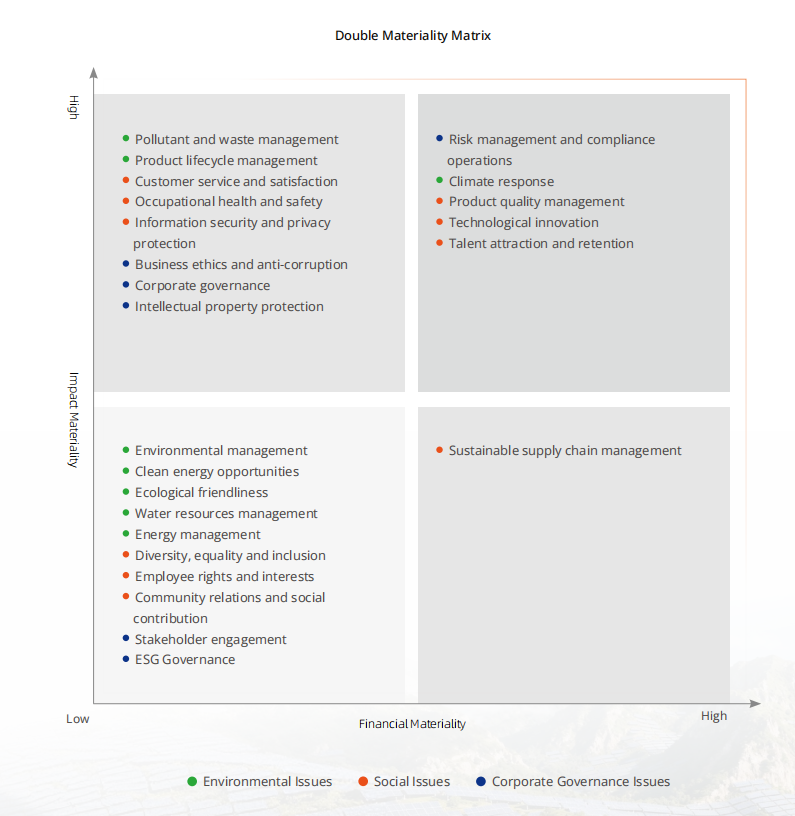
ESG Matrix
AIKO places great emphasis on its various stakeholders. In line with the characteristics of the industry and its business operations, the company has established multiple communication channels with stakeholders such as government and regulatory agencies, investors, customers, employees, suppliers, and communities to promptly understand their expectations and demands and respond proactively. Adopting the principle of double materiality, the company conducted its annual materiality assessment for 2025. By comprehensively considering the impact materiality and financial materiality of issues of concern to both internal and external stakeholders, the company screened and analyzed issues of high materiality, forming a materiality matrix. These issues are disclosed and addressed as a priority. In 2025, a total of 5 double materiality issues, 6 financial materiality issues, and 13 impact materiality issues were identified.
The Sustainable Development Goals
The Sustainable Development Goals (SDGs) adopted by the United Nations are a universal call-to-action to end poverty, protect the environment, reduce economic inequality and ensure peace and justice for people. We identified the 13 out of total 17 SDGs that are most relevant to our ESG strategy and highlighted our performance against these SDGs throughout our ESG report.
Click module to learn more.
123456789101112131415161712345678910111213141516171234567891011121314151617
NO POVERTY


End poverty in all its forms everywhere


Our SDG Response:

• Made donations to support philanthropic cause

• Fulfilled corporate responsibility through engagement in volunteer activities


Community relations and social contributions


GOOD HEALTH AND WELL-BEING


Ensure healthy lives and promote well-being for all at all ages


Our SDG Response:

• Established a comprehensive environmental health and safety management system

• Regularly identified occupational health risks

• Offered employees complimentary health screenings


Occupational Health and Safety

QUALITY EDUCATION


Ensure inclusive and equitable quality education and promote lifelong learning opportunities for all


Our SDG Response:

• Established a comprehensive career growth system, offering employees a range of training opportunities

• Understood employees’ needs and helped them in achieving higher educational qualifications


Talent attraction and retention

GENDER EQUALITY


Achieve gender equality and empower all women and girls


Our SDG Response:

• Developed fair and impartial recruitment and promotion standards to foster a diverse, equal, and inclusive workplace

• Provided welfare activities for female employees


Diversity, equality and inclusion

ESG governance

CLEAN WATER AND SANITATION


Ensure availability and sustainable management of water and sanitation for all


Our SDG Response:

• Set water conservation goals for products

• Developed diversified alternative water sources

• Took water resource recycling measures

• Advanced a water-saving program across the supply chain


Water resources management

AFFORDABLE AND CLEAN ENERGY


Ensure access to affordable, reliable, sustainable and modern energy for all


Our SDG Response:

• Consistently drove technological innovation to enhance the clean energy efficiency

• Designed and manufactured superior PV products to enable a carbon-free society


Clean energy opportunities

Technological innovation

DECENT WORK AND ECONOMIC GROWTH


Promote sustained, inclusive and sustainable economic growth, full and productive employment and decent work for all 


Our SDG Response:

• Implement a long-term compensation and incentive mechanism to help promote stable employment in the regions where the company operates

• Strengthened industry-academia research collaboration to drive technological innovation and talent cultivation


Talent attraction and retention

INDUSTRY, INNOVATION AND INFRASTRUCTURE


Build resilient infrastructure, promote inclusive and sustainable industrialization, and foster innovation


Our SDG Response:

• Developed high-efficiency, highpower products

• Deepened cooperation with partners across multiple scenarios


Clean energy opportunities

Product lifecycle management

Product quality management

Technological innovation

Intellectual property protection


SUSTAINABLE CITIES AND COMMUNITIES


Make cities and human settlements inclusive, safe, resilient, and sustainable


Our SDG Response:

• Strengthened collaboration with peers and the community to achieve sustainable communities and cities

• Explored the building of carbon-free towns, islands, and cities


ESG governance

Stakeholder engagement

RESPONSIBLE CONSUMPTION AND PRODUCTION


Ensure sustainable consumption and production patterns


Our SDG Response:

• Conducted responsible procurement and green, low-carbon supply chain initiatives; traced the sources of conflict minerals and raw materials

• We strengthened the environmental management system, enhanced resource and energy utilization efficiency, and reduced pollutant emissions


Environmental management

Energy management

Pollutant and waste management

Product lifecycle management

CLIMATE ACTION


Take urgent action to combat climate change and its impacts by regulating emissions and promoting developments in renewable energy


Our SDG Response:

• Monitored climate change-related policies, improved internal governance and response plans, identified climate risks, and enhanced climate resilience

• Increased the proportion of clean energy use, promoted green electricity purchasing and rooftop PV projects, reduced carbon footprint


Response to Climate Change


PEACE, JUSTICE AND STRONG INSTITUTIONS


Promote peaceful and inclusive societies for sustainable development, provide access to justice for all and build effective, accountable and inclusive institutions at all levels


Our SDG Response:

• Strengthened risk management and internal control compliance to ensure stable business operations

• Conducted business ethics training for all employees and suppliers to create a clean and transparent environment


Risk management and compliance operations

Business ethics and anti corruption

PARTNERSHIPS FOR THE GOALS


Strengthen the means of implementation and revitalize the global partnership for sustainable development


Our SDG Response:

• Engaged in industry-academia research cooperation, supporting university academics, teaching, and graduate job opportunities

• Facilitated supplier exchanges

• Conduct sustainable supply chain empowerment training to enhance the understanding and practical capabilities of procurement department employees and suppliers regarding the concept of sustainable development
Community relations and social contribution

Sustainable supply chain management

image-and-text
ESG Governance
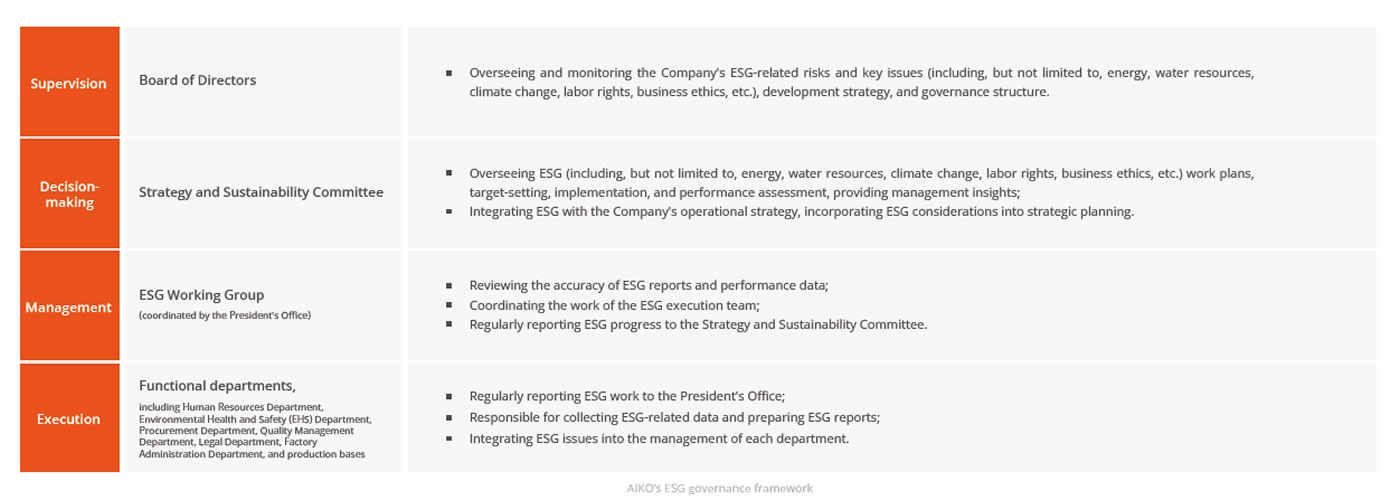
AIKO has established an ESG governance structure with the Board of Directors as the highest authority. We formulate and continuously improve the Implementing Rules of the Strategy and Sustainable Development Committee, and are committed to gradually integrating ESG-related tasks into our management system, steadily advancing ESG matters.
Significant Themes
Clean Energy Technology
AIKO has long endeavored to innovation-driven development and self-developed R&D. We sustained a high level of R&D investment that continues to grow, enhancing product efficiency, ensuring cost control, and achieving long-term reliability. We aim to drive leapfrog development across the entire industrial chain and jointly create a blueprint for a zero-carbon world.
3,788
Patent applications
565
R&D employees
352million
R&D cost
Significant Themes
Implementing Green Production
AIKO has established and improved its environmental management system and vigorously promoted the prevention and disposal of industrial waste to enhance resource and energy management. We adhere to the coordinated development of production and operation and environmental protection and strive for the low-carbon transformation of the energy and power industry.
98.04GWh
Annual electricity savings
1,865.8thousand tonnes
Annual water savings
Zhejiang AIKO
“National Level”Green Factory
Significant Themes
Responsible Supply Chain Management
AIKO is committed to conveying the concept of sustainable development to our upstream and downstream suppliers. We have established a supplier ESG (Environmental, Social, and Governance) risk assessment system and crafted the Supplier Social Responsibility Self-Assessment Form. By conducting risk reviews on suppliers in the areas of environment, society, and governance, we join hands with all partners to build a safe and win-win responsible supply chain under national laws.

100%
Usage ratio of compliant minerals
100%
Traceability coverage for tin-containing materials
650
Supplier exchange meetings
Significant Themes
Empowering Employees
AIKO regards human resources as the core driver of our sustainable development and social value creation. The company has established a dual career development path and an internal rotation mechanism to enhance employees’ diverse skills. We are committed to building a highly responsible, skilled, and proactive team dedicated to advancing a zero-carbon future.
10.1ten thousand hours
Total training hours
143.8million
Total training investment
100 %
Employee training coverage
ESG Report
Our commitments, long-term goals and annual report.
ESG Charter
We strive for transparency and a high level of accountability in our Environmental, Social and Governance (ESG) practices.

We welcome your feedback and invite you to send comments to our ESG Team

Frequent Asked Questions

Find answers to common questions about AIKO high-efficiency solar products.

01 Has your company established a formal ESG governance and management system?
Yes. The company has established an ESG management framework with clearly defined responsibilities. The Strategy and Sustainability Committee under the Board of Directors reviews and oversees significant ESG matters. Environmental, social, and governance activities are implemented through the company’s ESG policies, annual ESG reports, and relevant management procedures.
02 How does your company protect human rights and prohibit child labor, forced labor, and modern slavery?
The Supplier Code of Conduct and Human Rights Management Policy explicitly prohibit child labor, forced labor, debt bondage, human trafficking, and modern slavery. These requirements apply to the company’s employees, suppliers, and other business partners. The policies refer to the Universal Declaration of Human Rights, International Labour Organization conventions, and the UN Guiding Principles on Business and Human Rights. Measures such as identity verification, employee spot checks, and child-labor remediation procedures are implemented.
03 How does your company conduct human rights and ESG due diligence throughout its supply chain?
All suppliers are required to sign the Supplier Code of Conduct as a precondition for cooperation. The company conducts KYC and ESG due diligence on suppliers and performs on-site ESG audits of key raw-material suppliers. The audits cover labor rights, human rights, environmental compliance, and business ethics. Grievance and whistleblowing channels are available to employees and supply-chain stakeholders, and procurement personnel receive training on human rights due diligence.
04 How does your company manage conflict minerals, responsible sourcing, and supply chain traceability?
In accordance with the Responsible Minerals Initiative’s requirements, the company requires relevant suppliers to complete the Conflict Minerals Reporting Template. Due diligence is conducted on tantalum, tin, tungsten, and gold to prevent these minerals from directly or indirectly financing armed conflict in the Democratic Republic of the Congo or adjoining countries. The company gives priority to suppliers certified to standards such as ISO 14001 and ISO 45001 and requires raw-material suppliers to commit to responsible sourcing principles. A traceability system has also been established to track products and key components throughout the supply chain.
05 Has your company established an environmental management system and conducted environmental risk assessments?
Yes. The company has established an Environment, Health and Safety Management Policy and implemented an ISO 14001 environmental management system, supported by a defined management structure and operating procedures. Environmental risk assessments cover water use, waste management, emissions, local communities, and biodiversity. Although the company’s production facilities are mainly located in industrial parks and therefore have relatively limited direct impacts on biodiversity, these risks are still regularly identified and assessed.
06 How does your company manage occupational health and safety, and what is its recent health and safety performance?
The company has implemented an ISO 45001 occupational health and safety management system. It conducts hierarchical risk control, safety inspections, quarterly hazard identification, emergency planning, and annual emergency drills. In 2025, the company identified 5,608 hazards and achieved a 100% rectification completion rate. It conducted 187 safety emergency drills involving 9,807 participants and provided environmental and safety training to 27,173 participants. No work-related injuries, serious work-related injuries, or work-related fatalities were recorded.
07 What carbon reduction, net-zero, and product carbon footprint targets has your company established?
The company aims to achieve net-zero Scope 1 and Scope 2 greenhouse gas emissions by 2050. Compared with the 2024 baseline, it plans to reduce both absolute Scope 1 and Scope 2 emissions and emissions intensity per unit of product by 50% by 2030. Absolute Scope 1 and Scope 2 emissions are targeted to decrease by 80% by 2040. The company can also provide greenhouse gas verification statements, Environmental Product Declarations, and ISO 14067 product carbon footprint documentation.
08 What measures and targets does your company have for energy efficiency, water efficiency, resource conservation, recycling, and product take-back?
Answer: From 2026 to 2030, the company targets an average annual reduction of 5% in comprehensive electricity consumption per unit of product and an average annual reduction of 5% in comprehensive water consumption per unit of product. The company participates in the EU Waste Electrical and Electronic Equipment recycling scheme. It also promotes resource circularity through waste classification, recycling, compliant disposal, and hazardous-substance management.
09 How does your company manage business ethics, grievances, whistleblowing, confidentiality, and protection against retaliation?
The company has established a Business Ethics Management Policy and procedures for managing grievances, complaints, and reports. Reporting and grievance channels are available to employees and supply-chain stakeholders. When an employee grievance falls within the applicable scope, an investigation is initiated. A written response should normally be provided within five working days. If this is not possible, the reason for the delay must be explained, and the total response period must not exceed three months. Information is kept confidential throughout the process, and retaliation against complainants or whistleblowers is strictly prohibited.
10 Does your company participate in independent third-party ESG assessments, and does it conduct ESG audits of its suppliers?
Yes. The company participates in the EcoVadis assessment and accepts third-party social responsibility audits initiated by major customers, including audits conducted by organizations such as SGS. It also conducts annual on-site ESG audits of key raw-material suppliers. These audits cover environmental compliance, labor rights, human rights, and business ethics, and identified issues are followed through to corrective-action closure.