


Which is Better: 475W TOPCon vs AIKO ABC Solar Panels? (2026 Comparison)
February 14th, 2026
Quick Answer – The difference between 475W TOPCon & 475W ABC solar panels in 2026?
At first glance, 475W TOPCon and 475W ABC panels look identical on spec sheets—same wattage, similar dimensions, comparable pricing. But they’re built on completely different architectures with dramatically different futures.
TOPCon is a front-contact architecture that achieves high output by refining a design that still places metal collection structures on the light-receiving side. After 70 years of optimization, it has nearly reached its architectural ceiling at 475W.
ABC (All Back-Contact) moves all electrical contacts to the rear, removing front-side metal entirely and enabling 100% active front surface. This architecture made 475W possible as a starting point, then advanced to 500W, demonstrating substantial headroom for continued growth.
The tolerance gap widens the difference further. A 475W TOPCon panel with -3% to +3% power tolerance might actually be a 460W panel, while AIKO Infinite guarantees positive-only tolerance (0 to +3%), ensuring every panel is at least 500W and often reaching 515W. What appears as a 25W difference on the label becomes a 40-55W real-world advantage per panel that compounds over decades.
How AIKO changed 475W “standard” panels in Australia
In 2024, AIKO introduced something unprecedented to the Australian solar market: 475W in 54-cell format using ABC (All Back-Contact) architecture. At the time, the industry standard sat at 440W, so AIKO’s Neostar 475W represented a leap forward, resetting expectations of what a standard residential panel could deliver. From then, AIKO quickly extending the same 54‑cell platform to 480W, 490W and, by late 2025, a record‑breaking 500W module under 2 m².
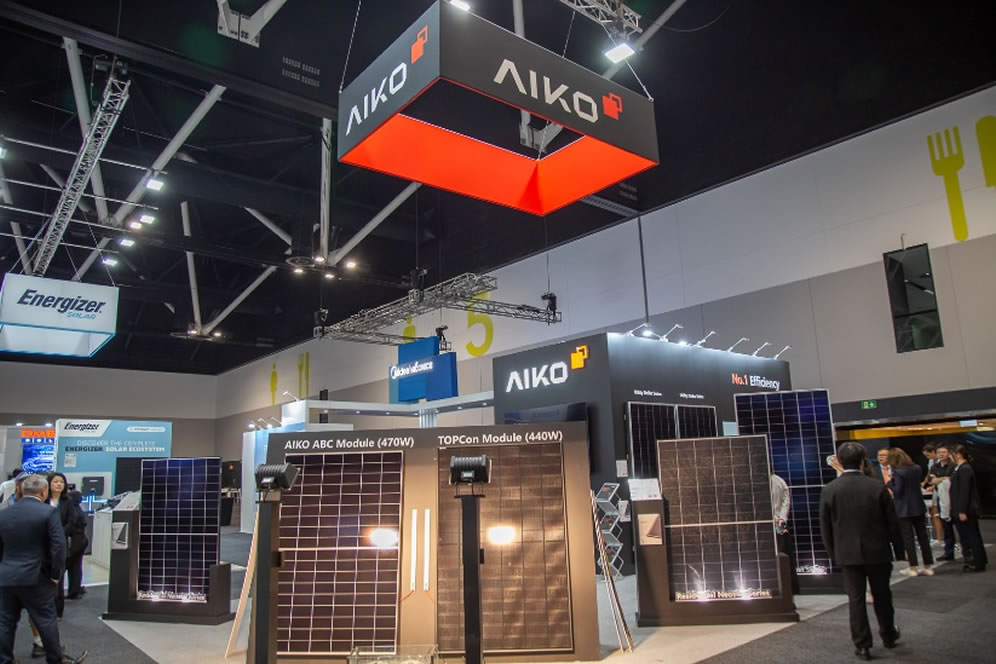
As we move into 2026, more manufacturers have arrived with “475W TOPCon” offerings, and 475W is becoming the new mainstream baseline. On the surface, all 475W panels look comparable: same output number, similar dimensions, competitive pricing.
But the story isn’t “everyone caught up.” This article explains why the technology behind how they reach 475W determines everything about their performance and your savings for the next 30 years.
Why Front‑Contact Solar Architecture Has A Ceiling
Most mainstream solar technologies—PERC historically and TOPCon today—share the same fundamental layout: metal contacts on both the front and rear surfaces of the solar cell. This front-contact design has been refined brilliantly over seven decades, but it carries structural limitations that become increasingly difficult to overcome.
- Front metal blocks light: Busbars and fine gridlines cover part of the front surface, so a portion of incoming light always hits metal instead of silicon, reducing potential power.
- Cell gaps waste area: Interconnection ribbons folding from front to back require several millimetres between cells, which reduces active area and energy density over the module.
- Silver‑paste limits conductivity: Screen‑printed silver remains the mainstream conductor, adding cost and constraining how far current collection can be pushed as efficiencies rise.
After roughly 70 years of continuous optimisation such as more busbars, narrower fingers, better pastes, passivation, texturing, and AR coatings, TOPCon is extracting almost everything this architecture can give, which is why 475W looks like a ceiling rather than a stepping stone.
AIKO All Back Contact: Advanced Technology Leading the Future
The concept of back-contact solar cells isn’t new. Researchers have explored putting all electrodes on the rear surface since the 1970s, recognizing the theoretical advantages:
- Eliminate front-surface light obstruction entirely
- Maximize light absorption (100% active front surface)
- Improve efficiency potential beyond front-electrode limits
For decades, back‑contact remained a niche technology because of alignment complexity and cost. AIKO spent years solving these challenges through intensive R&D, developing production-ready copper electroplating processes, creating precision alignment systems, and engineering automated processes with built-in quality control.
AIKO’s breakthrough was making back-contact commercially viable for mainstream installations at competitive pricing with guaranteed performance specifications. This commercialisation enabled AIKO to bring 475W to market and quickly advanced to 480W, 490W, and 500W in less than a year, demonstrating substantial headroom for continued growth.
Back-contact aligns with the industry’s long-term roadmap. Multiple major manufacturers have signaled that back-contact will become the dominant technology pathway beyond TOPCon. The International Technology Roadmap for Photovoltaic (ITRPV) projects back-contact architectures gaining significant market share as the industry seeks efficiency gains beyond what front-contact designs can deliver.When you choose ABC technology in 2026, you’re positioning yourself on the leading edge of where the entire solar industry is heading.
AIKO Infinite Technology: Four Breakthroughs from ABC Architecture
- ZeroGap Cell Layout
Infinite modules use high–precision lamination and interconnection to minimise spacing between cells. This recovers roughly 0.4% of previously lost area and translates directly into higher module efficiency. - InvisiRibbon Technology
By hiding interconnection ribbons from view, Infinite achieves a true full–screen look while increasing the light–receiving area by another 1.4%. The result is a sleek, uniform black module that appeals to homeowners and architects as much as it appeals to performance–driven installers. - Copper Interconnection
Instead of relying on silver–based paste, Infinite uses high–conductivity copper interconnections. Copper handles higher currents with lower resistance, improves thermal performance, reduces the risk of micro-cracks and long–term degradation, and lowers exposure to silver price volatility. - Two-Step Passivation
AIKO’s patented two–step passivation process decouples the formation of p–type and n–type tunnelling oxide and polysilicon layers. Each layer can be optimised independently, enabling cell conversion efficiency above 27% in mass production.
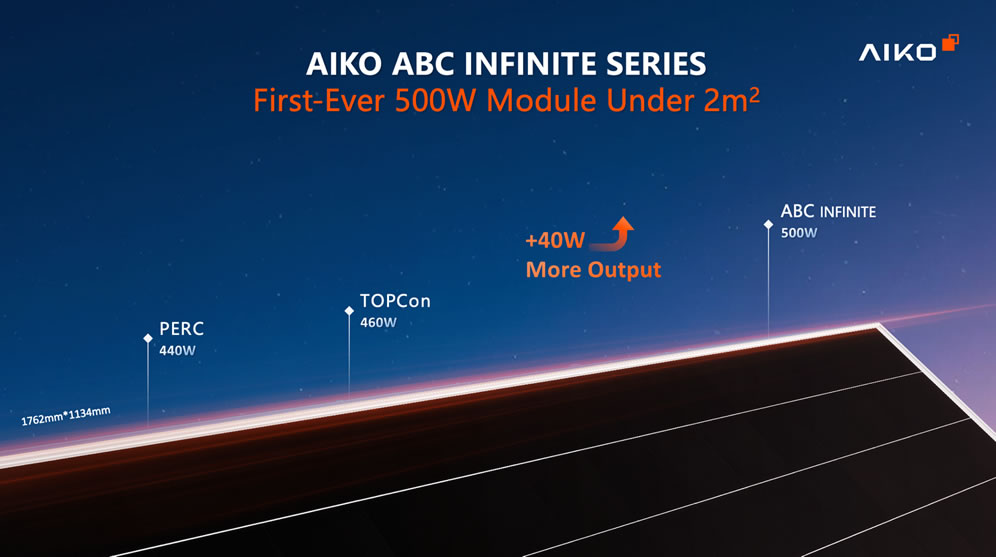
Together, these four innovations increase the module’s light-receiving area by 4.8% compared to front-contact designs. This enabled AIKO to reach 500W and 25% module efficiency in a compact residential format without requiring extra roof space.
Why this turning point matters for Australian households
Only a few years ago, a 300W panel was considered “high power,” but those systems now struggle to keep up with all-electric homes running EV charging, heat pumps, and electric cooking. The pattern is repeating.
In 2026, the 400-440W panels that became the default over the last few years are starting to look undersized for rising energy demand. As your household electrifies—adding EVs that need 7-11kW charging, heat pumps pulling 3-5kW continuously, batteries requiring 3-5kW to charge during solar hours—your roof space becomes increasingly valuable.
For most homes, the question is not simply about 475W or 500W but more about how much energy you can generate from limited roof as your consumption grows.
Many TOPCon panels are rated with tolerances such as −3% to +3%, meaning a ‘breakthrough’ 475W TOPCon might just be a relabelled 460W panel. Meanwhile, AIKO Infinite 500W ABC modules are specified with positive-only tolerance (0 to +3%), guaranteeing each panel is at least 500W and often reaching 515W. The truth is, when comparing TOPCon 475W and AIKO ABC 500W, a 25W difference on label can be a 40-55W gap in real-world performance per each panel.
The Cost of Choosing Ceiling Technology
Choosing ceiling technology means accepting multiple compounding disadvantages over 30 years:
- Wasted roof space due to lower actual output per panel
- Underperformance risk from negative tolerance
- Performance locked while your consumption increases with EVs, batteries, heat pumps, and full electrification
- Lost savings accumulating year after year and forced expensive grid purchases
Solar panels you install in 2026 will likely still be on your roof in 2056. That’s not just panels—it’s three decades of electricity generation, bill savings, and energy independence you’re choosing today. Find certified AIKO installers near you to understand more about the technology behind the numbers and protect your savings.
FAQ
Q:Are all 475W solar panels basically the same quality
A: No—wattage doesn’t tell the whole story. Check: (1) Architecture (front-electrode vs back-contact determines ceiling vs potential), (2) Tolerance (some “475W” panels may be 470W actual), (3) Manufacturing quality (certifications, warranties, company track record), (4) Advancement capacity (has architecture peaked or can it grow?). Same wattage can mean very different long-term value.
Q: If both panels are 475W, will they generate the same electricity?
A: No. While they have the same “peak” rating in a lab, the AIKO 475W ABC panel will typically generate more total energy (kWh) over a year. This is due to its better performance in high heat (lower temperature coefficient) and superior shade management compared to TOPCon technology.
Q: Why is ABC technology better than TOPCon for 475W panels?
A: ABC technology removes metal gridlines from the front of the panel, allowing it to absorb 100% of the sunlight. To reach 475W, TOPCon panels have to be pushed to their design limits, whereas 475W is well within the “comfort zone” for ABC technology, ensuring better long-term reliability.