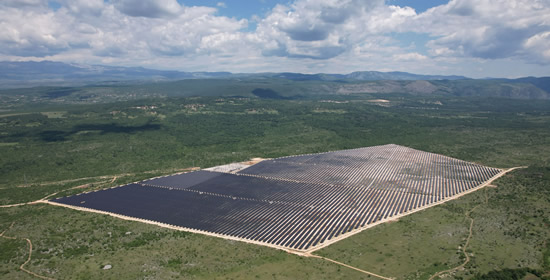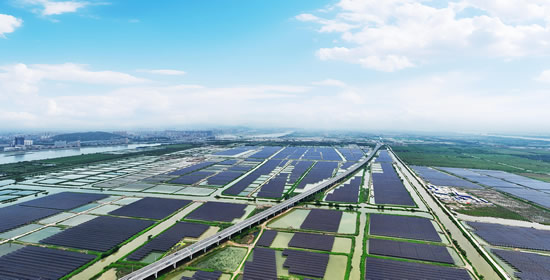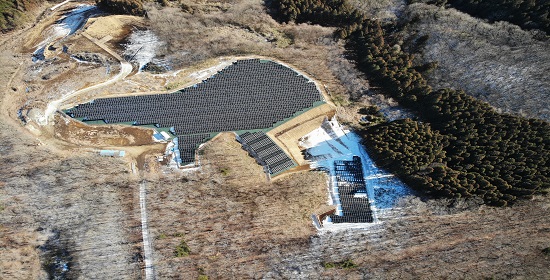
Datang Guangxi Guiguan Rongan Matian 100MW PV Project:
A New Benchmark for Efficient and Intensive Mountainous PV Construction
As a traditional agricultural county, Rongan in Guangxi urgently needed a new engine for economic growth. This PV project was positioned as a core initiative of the “Agrarian-to-Industrial” strategy. It was designed not only to bring in fixed-asset investment, tax revenue, and numerous jobs but also to lead upstream and downstream industrial clustering, driving a fundamental transformation and upgrade of the local economy. The successful grid connection of this project represents more than just an efficiently built clean energy facility; it serves as a replicable demonstration model for intensive mountainous PV development and green regional transformation.
Results Demonstration
100 million kWh
Annual power generation
53,660 tons
Annual CO₂ emissions reduction
30,000 metric tons
Annual standard coal saved
158,417 trees
Equivalent to annual tree planting

Project Challenges
Mountainous PV construction must address specific challenges, including difficult terrain, land-use efficiency, policy requirements, and grid absorption pressures. Irregular and limited usable land in mountains requires higher installed capacity within a smaller footprint to reduce the number of brackets and foundation piles. Furthermore, mountain terrains are often exposed to extreme weather like strong winds and heavy snow, necessitating modules with enhanced mechanical load capacity and superior glass strength. Additionally, slope-induced shading is a major hurdle; modules with optimized shading tolerance and bifacial technology are required to leverage reflected light and maximize energy yield per watt.


Solution
The project installed 158,460 units of AIKO Stellar Series N-type 72-cell ABC Dual-Glass modules, reaching a total capacity of 100MW. In challenging mountainous environments, AIKO ABC modules stand out as the premium performance benchmark. Their world-leading conversion efficiency enables higher power density, significantly reducing land usage and lowering Balance of System (BOS) costs, such as racking and cabling. Moreover, the unique Partial Shading Optimization and excellent micro-crack resistance of ABC technology ensure stable power output even in complex terrains where shading is unavoidable.
Related Projects